
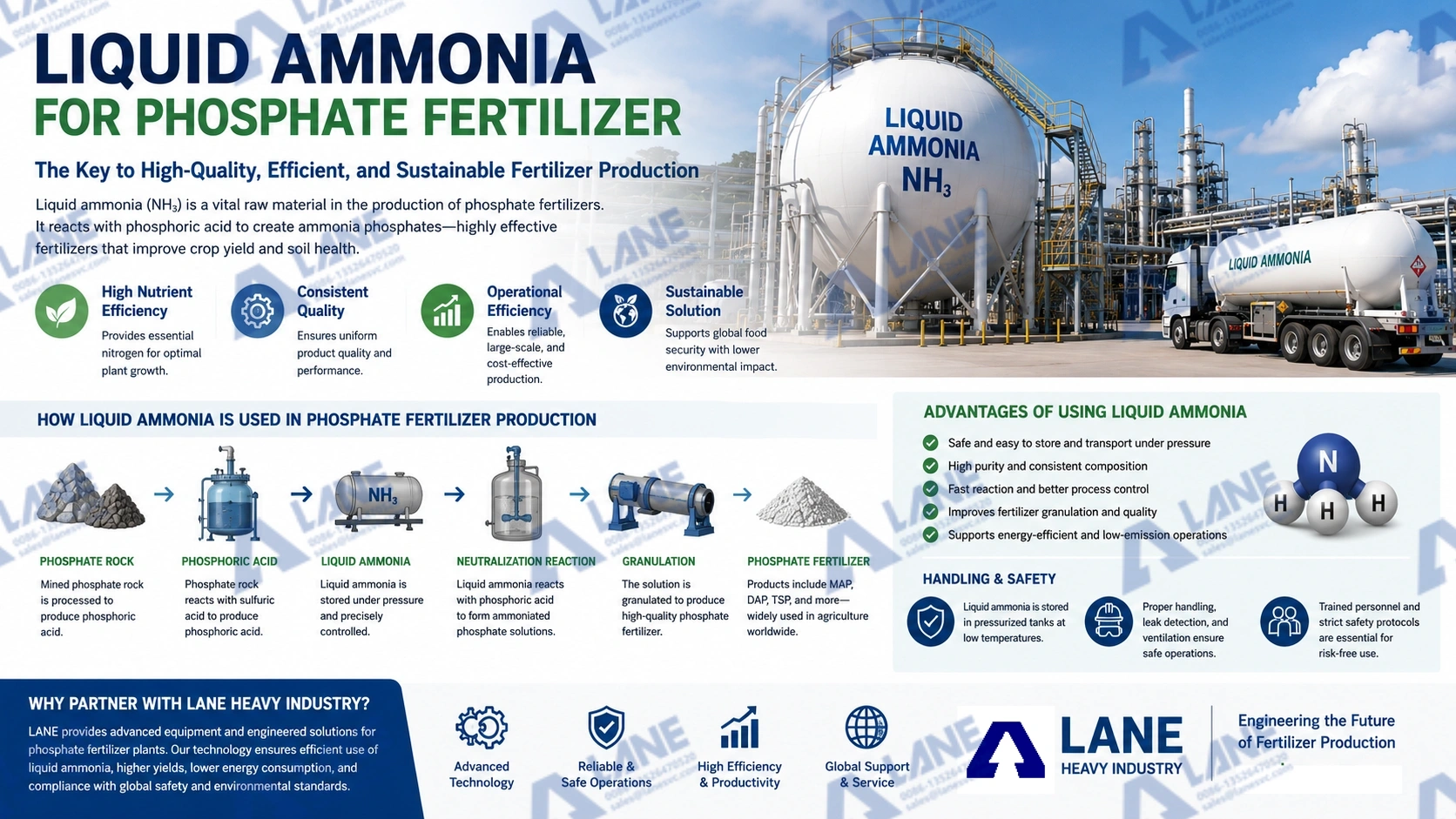
Fertilizer industry is continuously trying to reduce the cost of producing fertilizer while increasing quality and yield. Liquid ammonia for phosphate fertilizer has emerged as a highly efficient and cost-effective solution. it can improve reaction efficiency, reduce scaling risk, and support simpler continuous processing. Modern phosphate fertilizer plants rely on liquid ammonia because it improves reaction efficiency and reduces raw material waste, lowers energy consumption, and supports automated continuous production.
While the economic advantages of liquid ammonia for phosphate fertilizer are clear, handling anhydrous liquid ammonia requires Advance engineering and control due to its volatile properties. LANE Heavy Industry addresses this by strict quality. Every piece of machinery designed for the ammoniated phosphate fertilizer line undergoes strict quality checks compliant with the ISO9001 quality management system. In a well-designed line, especially one based on LANE Heavy Industry’s DAP production line, it can help manufacturers cut operating costs while maintaining granulation quality and stable output.
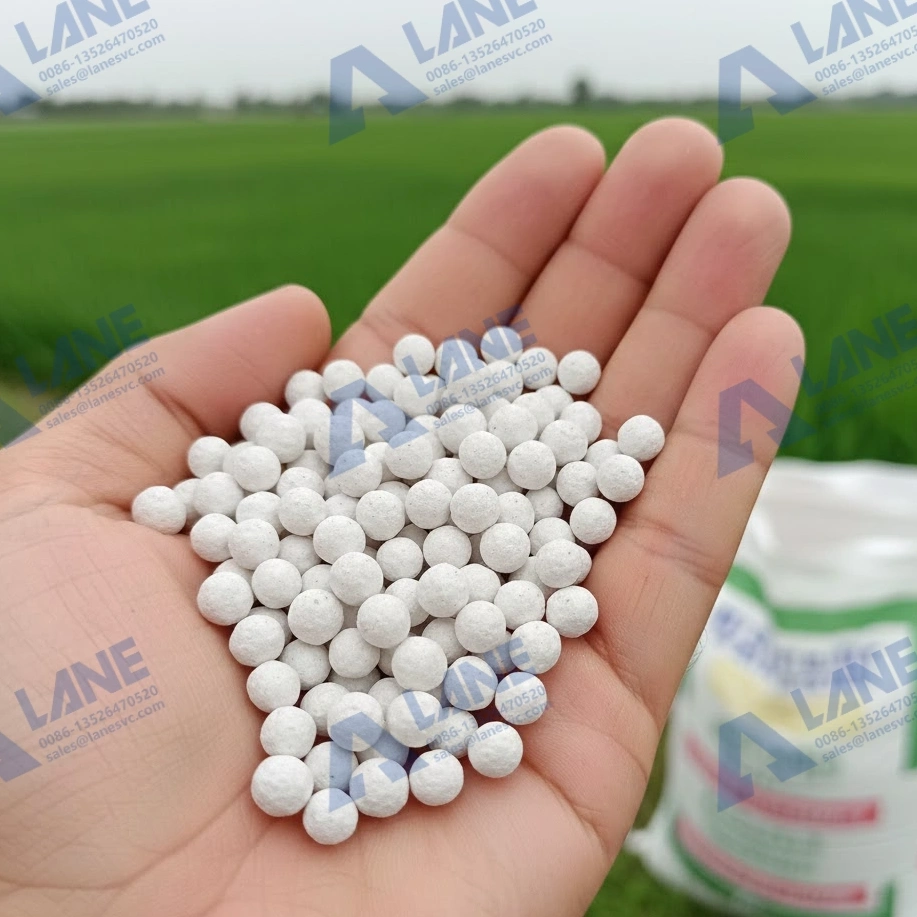
Liquid ammonia for phosphate fertilizer refers to the use of liquefied ammonia as a nitrogen source during the production of phosphate-based fertilizers such as:
In liquid ammonia for phosphate fertilizer production, ammonia reacts with phosphoric acid to form ammonium phosphate products such as MAP and DAP. LANE Heavy Industry’s DAP production line follows systematic process of raw material preparation, neutralization, granulation, drying and cooling, screening, and packaging. A process built around liquid ammonia can improve feeding control and reaction consistency. Stable neutralization directly affects slurry quality and granulation performance.
Liquid ammonia is easier to meter precisely in an automated line. This precision helps producers avoid under-ammoniation or excess free acid, both of which can hurt product quality and create downstream inefficiencies.
In practice, better control over the reaction stage can translate into less off-spec product, fewer interruptions, and lower rework. The growing popularity of liquid ammonia for phosphate fertilizer production is linked to this need for optimization in the production process.
Transitioning to a production model that utilizes liquid ammonia for phosphate fertilizer delivers measurable cost reductions across several operational areas:
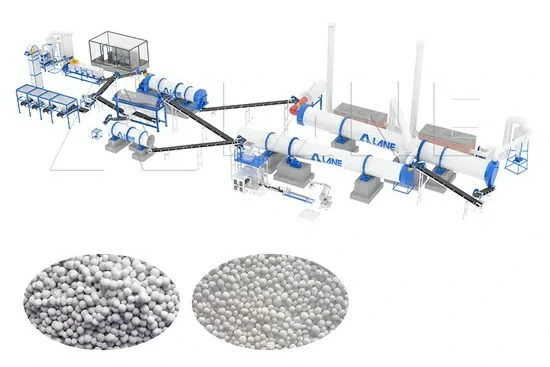
Implementing a process centered on liquid ammonia for phosphate fertilizer requires specialized machinery engineered to withstand precise chemical reactions, high vapor pressures, and strict emissions compliance. LANE Heavy Industry has developed an integrated phosphate fertilizer production line configured to manage this liquid-to-solid phase transformation with high thermal efficiency and absolute operator safety.
The integration of liquid ammonia for phosphate fertilizer begins at the pre-neutralization stage. LANE Heavy Industry’s reaction vessel or advanced pipe reactor system allows liquid ammonia to flash boil into gaseous form immediately prior to contacting the phosphoric acid stream. This precise metering ensures rapid, homogenous neutralization, generating a highly concentrated, low-moisture chemical slurry that is ready for immediate mechanical granulation.
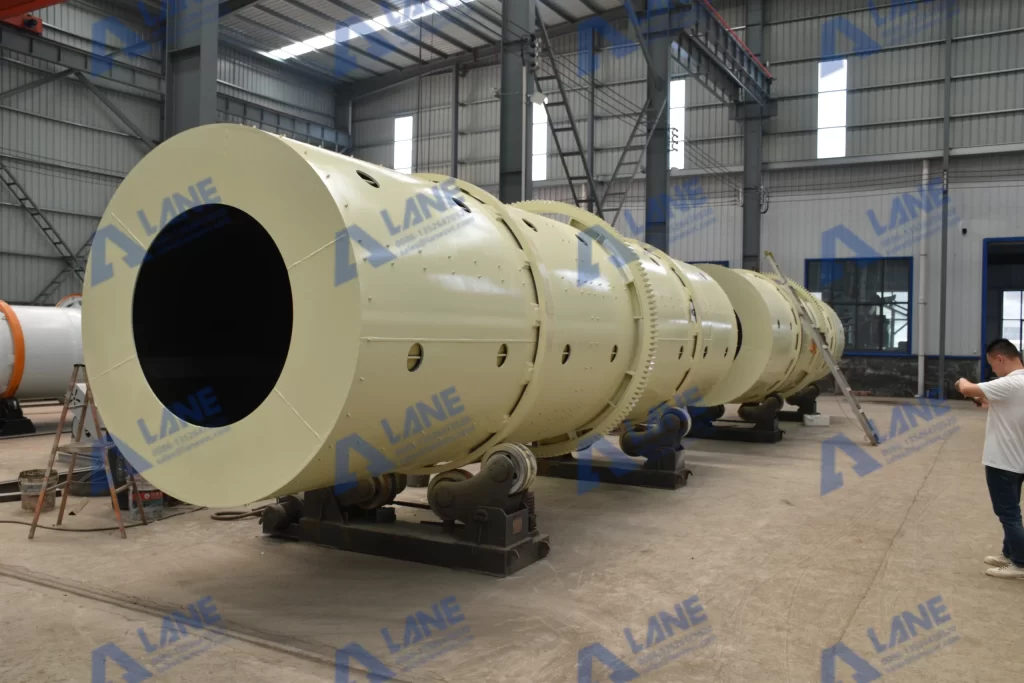
The heart of LANE Heavy Industry’s manufacturing system is the specialized Rotary Drum Granulator. It is engineered with an internal corrosion-resistant liner and custom-configured sparger pipes, the drum accepts the hot ammonium phosphate slurry. As the material cascades through the rotating shell, additional liquid ammonia is sparged beneath the rolling bed of material to achieve the final, precise N:P stoichiometric ratio.
The mechanical action of LANE’s drum granulator optimizes the natural cohesion of the reacting slurry. This maximizes the single-pass granulation yield and drastically lowers the recycling ratio of off-spec fines, decreasing the mechanical wear and energy demand across the entire circuit.
Engineering Advantage:Â LANE Heavy Industry builds its rotary drum shells from high-grade carbon steel plates supported by heavy-duty forged steel tires. This rigid construction prevents structural flexing caused by thermal gradients from the exothermic ammoniation reaction, ensuring decades of reliable, continuous operation.
The chemical slurry enters the granulation phase at an elevated temperature with optimized moisture levels. The already hot granules reduce the pressure of thermal load placed on LANE’s downstream Rotary Dryer. The residual moisture is easily driven off using minimal burner fuel. Following the drying stage, the hot granules pass into LANE’s Rotary Cooler, which utilizes high-velocity air streams to quickly lower the core temperature of the fertilizer grains. This prevents caking during storage and readies the product for final screening and coating.
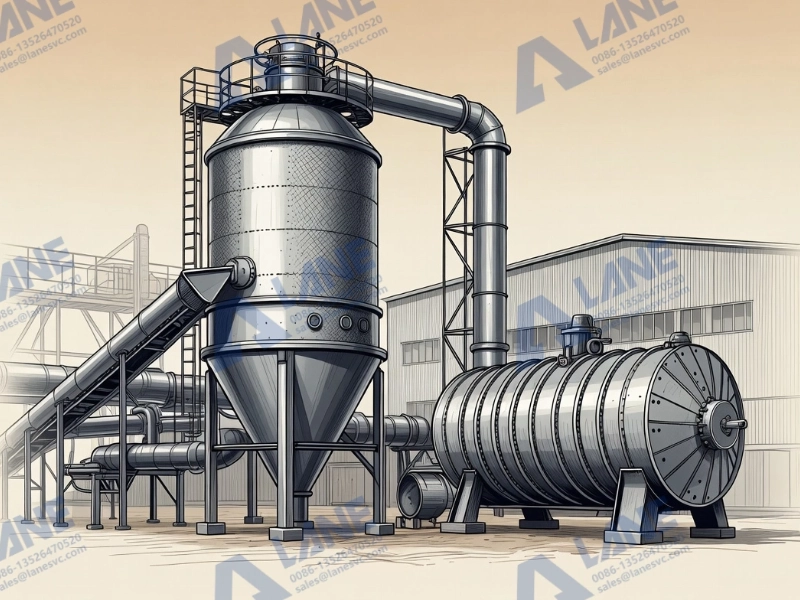
This is an essential component of any production line utilizing liquid ammonia. It is an advance vapor recovery network. LANE Heavy Industry integrates a highly efficient, closed-loop venturi scrubbing system directly into the granulator and dryer exhaust ducts. This system captures escaping ammonia vapors and scrubs them with the incoming phosphoric acid feed. This loop ensures zero chemical waste, captures unreacted nitrogen, and reintroduces it into the system to maintain raw material cost-efficiency.
liquid ammonia for phosphate fertilizer can lower costs in several ways:
The granulation process is more stable and the moisture need for the downstream process is removed. The drying process also requires less heat energy. An ammonia-related reactions can be used to maintain favorable process temperature, which supports efficient granulation and lower material input cost. That does not eliminate energy demand for liquid ammonia for phosphate fertilizer, but it can reduce waste in the system.
As a professional fertilizer equipment manufacturer, LANE Heavy Industry provides complete liquid ammonia for phosphate fertilizer solutions for global customers.
The company offers:
The company’s advanced engineering solutions help customers reduce investment risks while maximizing long-term profitability.
Q1: Is liquid ammonia always cheaper than other ammonia forms?
Not always. The total cost depends on storage, transport, safety systems, and how efficiently the plant can use it in the reaction and granulation stages.
Q2: Does liquid ammonia improve fertilizer quality?
It can, because more precise dosing helps maintain a stable reaction and more uniform slurry, which supports consistent granule quality.
Q3: Is liquid ammonia suitable for DAP production lines?
Yes. DAP production is based on the reaction of phosphoric acid and ammonia, so liquid ammonia is a natural fit for well-designed DAP lines.
Q4: What is the biggest cost-saving benefit?
The biggest benefit is usually processing stability: less scaling, fewer shutdowns, better granulation, and lower drying load.
For more details, please feel free to contact us.
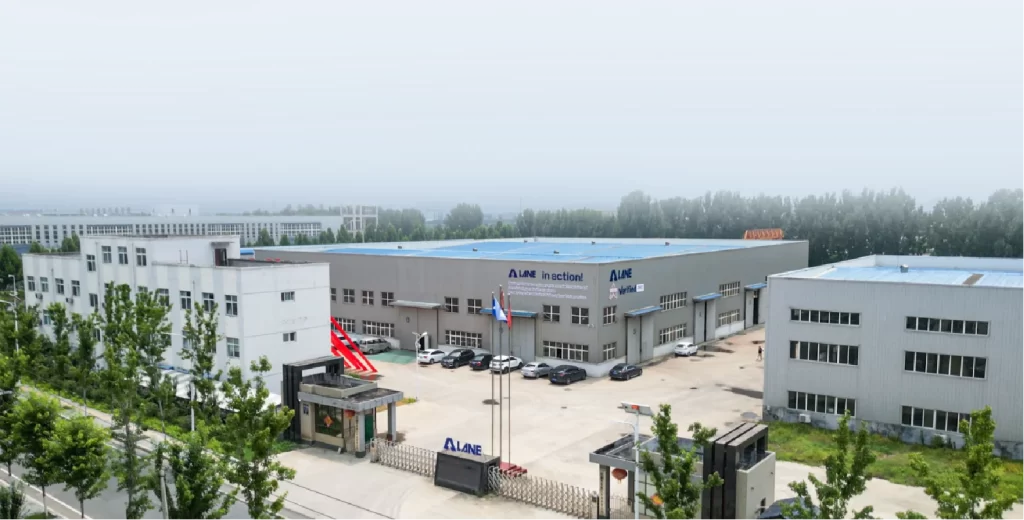
Henan Lane Heavy Industry Machinery Technology Co., Ltd.
Email: sales@lanesvc.com
Contact number: +86 13526470520
Whatsapp: +86 13526470520

Copyright © Henan Lane Heavy Industry Machinery Technology Co., Ltd.
