
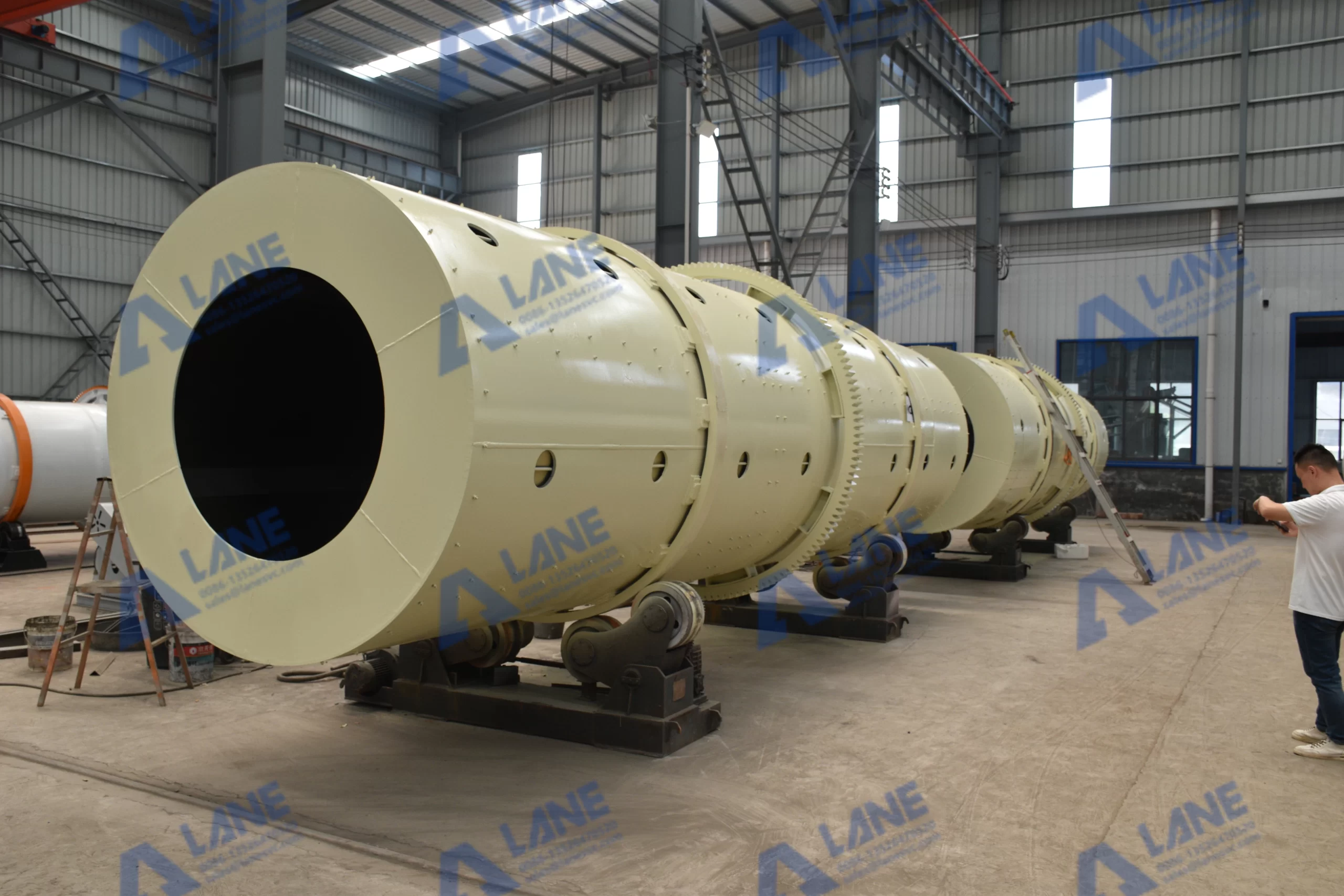
In the world of commercial agriculture, the true value of a bulk fertilizer is proven in the soil. But long before the application of the fertilizer, the crop-boosting potential of the fertilizer is determined in the production facility. The distance between a premium, high-value granules and a wasted batch of raw materials is measured in millimeters in an industrial production facility. Producing Diammonium Phosphate (DAP) or NPK granules is not a matter of mixing ingredients. The rotary drum granulator for DAP fertilizer production line plays a decisive role in determining product quality, nutrient efficiency, and overall production stability.
Choosing a highly engineered, precision-calibrated rotary drum granulator for DAP fertilizer production line systems is one of the most critical factors separating high-performance plants from inefficient plant. For producers, LANE Heavy Industry’s has created an efficient production line, that can produce premium commercial DAP fertilizer in large scale.
In the fertilizer sector, successful premium quality granules fall within the target size range of (2-4.75 mm) and preservation of the targeted chemical nutrient composition. The consistent NPK percentage can increase your brand reputation. Here is how an optimized rotary drum granulator for DAP fertilizer production line governs the outcomes:
An Unoptimized granulator reduces the granule efficiency and provides variations in particle size. Unoptimized granulators suffer from high variations in particle size distribution. If the drum granulator allows materials to slip rather than roll smoothly, it generates an excess of fines and over size lumps. This increase the recycle ratio, where up to 40% to 50% of the materials must be sent back to the crushing stage.
A customized rotary drum granulator for DAP fertilizer production line from LANE Heavy Industry reduces the recycle ratio to under 15–20%. It establishes a reliable and predictable agglomeration kinetic; the machine maximizes the direct yield of premium on-size granules on the first pass. This increases the hourly output capacity of the whole production line.
Ammonia volatilization is one of the primary threat to nitrogen yields during the DAP synthesis reaction. When the liquid-to solid contact is erratic, unbound ammonia escapes the material bed as gas. This causes air pollution, scrubbing challenges but most importantly it degrades the nitrogen content of your final compound fertilizer. This changes your targeted 18-46-0 formula down to an off-spec grade.
An advanced rotary drum granulator for DAP fertilizer production line manages the depth, pressure, and temperature profiles of the material bed. This containment ensures that chemical reactions occur uniformly within the slurry-solid matrix and traps the nitrogen and phosphorus molecules inside the granule core to granulate your intended nutrient ratio.
Performance Benchmark Comparison
| Performance Indicator | Standard Rotary Drum Granulator | LANE Heavy Industry Specialized Granulator |
| First-Pass Granulation Yield | 55% – 65% on-size product | 85% – 92% premium on-size product |
| Average Recycle Ratio | 1:1.5 up to 1:2.0 | 1:0.2 up to 1:0.5 (Significantly Reduced) |
| Ammonia Fixation Efficiency | 88% – 92% (High gas loss) | 97.5% – 99.2% (Maximum N Retention) |
| Internal Lining Longevity | 12 – 18 months (Standard Metal) | 48+ months (High-Molecular Rubber/UHMWPE) |
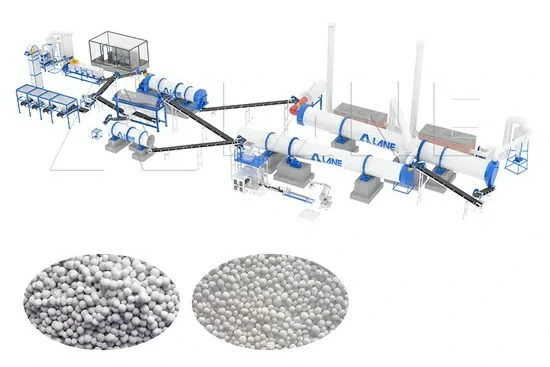
Advance fertilizer production line relies on every machine of the production line to work synchronal to get premium granules. The precision era of fertilization requires machinery capable of handling the raw material and slurry of the DAP fertilizer production. he rotary drum granulator for DAP fertilizer production line from LANE is designed as part of a complete production ecosystem.
Before granulation, materials pass through ammoniation reactors, where initial chemical reactions begin. The DAP reaction is a two step process, where phosphoric acid is reacted with ammonia nitrate.
The reactor is connected to the rotary granulator where the granulation process happens. After granulation the granules pass through rotary drum dryers and cooling drums. The materials needed to be dried to reduce moisture content and then cooled to stabilize granule hardness.
After the temperature control phase, the granules are classified according to size with the help of screening machine. oversized and undersized particles are recycled back into the rotary drum granulator for DAP fertilizer production line for reprocessing. The on-size granules moves to the coating machinery where the granules are coated with oils, micronutrients, or minarets according to formulations. The finished granules are then packaged using LANE Automatic packaging machine and ready for distribution or storage.
Structural Design Factors That Impact Performance
Not all granulator works at the same efficiency. The structural design of the rotary drum granulator for DAP fertilizer production line determines its efficiency and output quality.
Key design factors include:
Drum inclination and rotation speed: A well-designed and calibrated rotary drum granulator for DAP fertilizer production line maintains a balance between residence time and rolling intensity.
Lining plate structure:Â Wear-resistant lining improves the service life and enhances granulation efficiency of the rotary drum granulator.
Spraying system accuracy:Â The Granulator is equipped with customized liquid distribution system which ensures uniform granule formation in the rotary drum granulator for DAP fertilizer production line.
Internal airflow control: Proper airflow is one of the most important aspect of the modern granulator. It stabilizes chemical reaction and drying inside the rotary drum granulator for DAP fertilizer production line.
Optimization Strategies for Higher Yield
To maximize production efficiency, operators must continuously optimize the rotary drum granulator for DAP fertilizer production line:
LANE Heavy Industry designs systems, where the production line is integrated with smart control panels, allowing real-time adjustments for better NPK balance
When optimized correctly, the rotary drum granulator for DAP fertilizer production line can increase yield efficiency by reducing recycle rates and improving granule formation speed.
It provides continuous operation, high capacity, and excellent control over granule size, making it ideal for large-scale compound fertilizer production.
It ensures even distribution of raw materials during granule formation, preventing nutrient segregation and improving product consistency.
They typically offer systems ranging from 5 T/H to over 30 T/H, customizable based on plant requirements.
By optimizing moisture content, drum speed, internal structure, and using a high-quality rotary drum granulator for DAP fertilizer production line.
For more details, please feel free to contact us.
Henan Lane Heavy Industry Machinery Technology Co., Ltd.
Email: sales@lanesvc.com
Contact number: +86 13526470520
Whatsapp: +86 13526470520
Copyright © Henan Lane Heavy Industry Machinery Technology Co., Ltd.
