
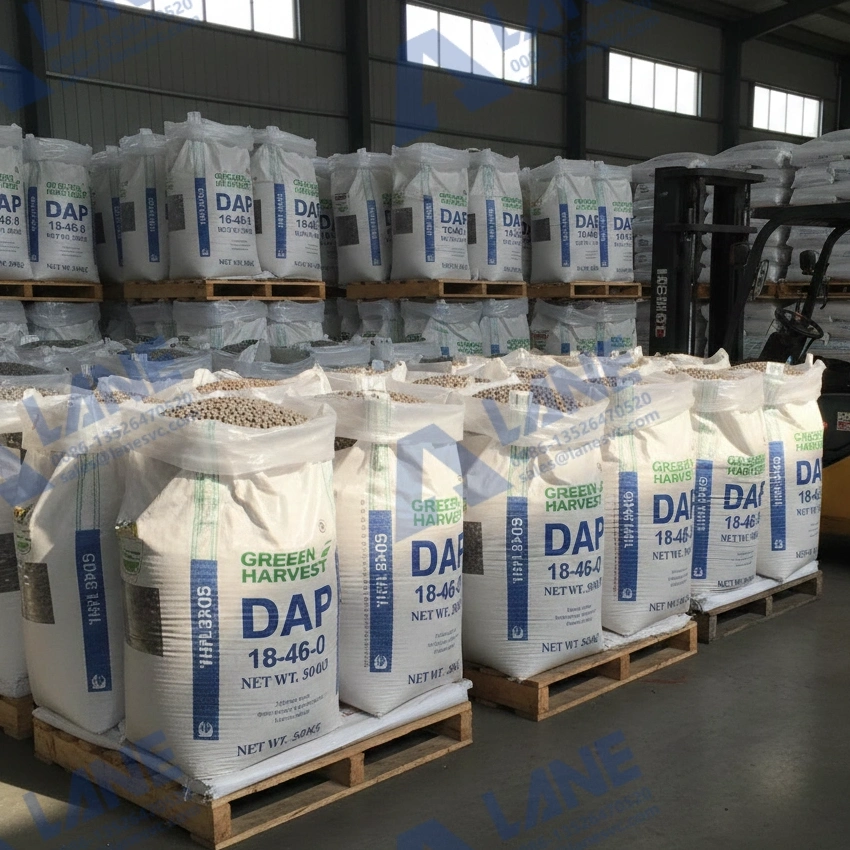
Growth in global agriculture means growth in fertilizer demand. But meeting that demand requires more than just building a large fertilizer production plant. In the Modern fertilizer manufacturing, the producers are in constant pressure for making high quality fertilizer efficiently and profitably. Manufacturers need a production system that delivers consistent quality, efficient operations, and strong returns on investment. Among the phosphate fertilizers, Diammonium Phosphate (DAP) is one of the most used fertilizers due to its balanced nutrient content and excellent agronomic performance. The 50 TPH DAP production system engineered by LANEÂ has become popular because it delivers consistent quality, efficient operations, and strong returns on investment
creating or expending a fertilizer business requires careful evaluation of production costs, equipment reliability, market demand, and future growth potential. The 50 TPH DAP production system is a suitable investment because it balances between production capability and financial sustainability.
LANE Heavy Industry specializes in engineering and manufacturing complete fertilizer production lines, and its 50 TPH DAP production system has become a preferred solution for medium and large-scale fertilizer producers worldwide.
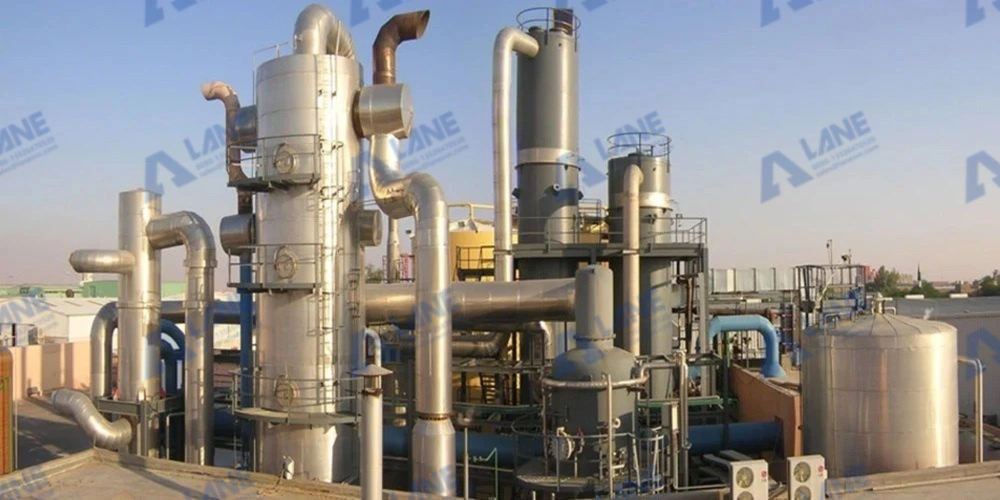
For a fertilizer producer, scaling to 50 TPH DAP production system is effective, because scaling too slowly means losing market share to larger competitors who can offer better bulk prices. Scaling up too quickly by jumping to a 100+ TPH system can cripple a growing company with astronomical upfront costs, complex regulatory hurdles, and underutilized capacity during seasonal demand.
As the demand for fertilizer continues to grow, 50 TPH DAP production system becomes a popular choice because it balances output, investment, and operational efficiency. Operating at full capacity, a 50 TPH line can yield up to 1,200 tons of high-quality DAP granules per day in a standard 24-hour operational cycle. This volume allows manufacturers to secure large-scale commercial contracts, service vast distribution networks, and lower per-ton production costs through bulk raw material purchasing.
A major advantage of 50 TPH DAP production system is lower investment risk. Compared to a 100 TPH or larger facilities, it requires less capital for equipment, construction, and installation The shorter commissioning period also helps manufacturers achieve a faster return on investment.
Producers can adjust output based on seasonal demand and changing market conditions while maintaining efficient operations. This adaptability makes the 50 TPH DAP production system a practical and profitable solution for growing fertilizer manufacturers seeking long-term success.
Excellent Return on Investment: One of the main reasons manufacturers invest in a 50 TPH DAP production system is its strong profitability potential. The production scale provides an excellent balance between capacity and operating costs. This allows producers to benefit from economics at scale without the high financial burden associated with larger plants. With high production efficiency, lower labor costs per ton, and reduced maintenance due to high quality materials, manufacturers can achieve faster payback and stronger long-term investment.
Reduced Operating Costs: Operating cost is one of the major spenders of any fertilizer production line. LANE Heavy Industry’s 50 TPH DAP production system incorporates energy saving motors and smart AI technologies designed to improve efficiency throughout the production process. Our system features optimized drying systems, heat recovery solutions, streamlined material handling, and automated process controls which help reduce energy consumption and minimize waste. As energy prices continue to rise, these efficiency improvements can generate significant cost savings over the life of the plant.
Higher Product Quality: Consistent product quality is essential for maintaining customer trust. quality products get premium market prices. A modern 50 TPH DAP production system is designed to produce fertilizer granules with premium size, higher nutrient content, excellent particle strength, and superior storage stability.
Scalability for Future Expansion:Â Many fertilizer producers begin with a single production line and scale as the market demand increases. We at LANE design production line with future growth in mind. It allows manufacturers to increase capacity through additional processing equipment, expanded storage facilities, or upgraded packaging systems. This flexible approach enables business to grow gradually while controlling investment costs.
Environmental Benefits: Environmental compliance has become a necessary requirement for fertilizer manufacturer worldwide. The 50 TPH DAP production system from LANE Heavy Industry incorporates dust collection system minimizes particulate emissions and gas scrubbing systems effectively control ammonia, fluoride, and other process-related gases. Our recycling system returns reusable material back into the production. This reduces waste and improve raw material efficiency. These environmental feature supports regulatory compliance and helps manufacturer build sustainable and competitive business.
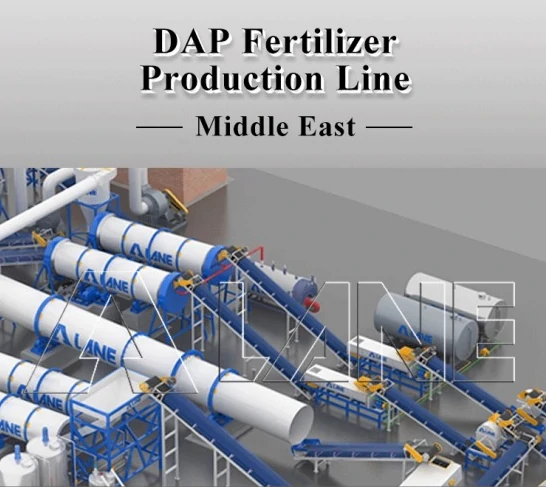
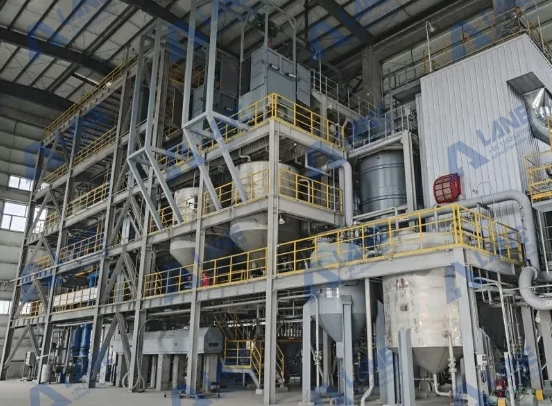
LANE Heavy Industry has engineered a comprehensive DAP fertilizer production line that integrates raw material preparation to final packaging into an automatic system. The core process stages of a LANE production lines are:
Raw Material Preparation: The system begins with precise handling of phosphoric acid and ammonia. They are essential raw material for DAP production. LANE’s storage and feeding systems minimize contamination and moisture variation, ensuring consistent reaction conditions.
Neutralization Reaction: This is the heart of the production line. In this process, phosphoric acid and ammonia is reacted in a neutralization tank to form ammonium phosphate slurry. the reactor is equipped withs sensors that feed data to the controller/ LANE’s automated system monitors the data from sensors and can automatically control and maintain temperature, pH, and molar ratios. This eliminates any human error and help producer achieve 18% nitrogen and 46% P₂O₅ composition.
Granulation:Â The slurry is fed into industrial granulator where rotary drum or disc systems transform it into uniform granules. The granule consistency is vital for application ease, storage stability, and nutrient release uniformity.
Drying and Cooling:Â Rotary dryers remove moisture via heated airflow, followed by cooling systems that prevent caking. This stage ensures stable moisture content and physical granule strength.
Screening and Packaging High-precision screens separate finished granules from fines or oversized particles. Automated packaging machines handle weighing, bagging, and sealing, minimizing labor costs while maximizing throughput.
Key Equipment in LANE’s System
| Equipment Category | Function |
| Neutralization/Reaction Systems | Controlled chemical reaction with automated monitoring |
| Granulators | Uniform granule size and nutrient distribution |
| Rotary Dryers | Moisture removal via heated airflow |
| Cooling Systems | Prevent particle agglomeration |
| Screening Machines | Separate qualified products from off-size material |
| Packaging Machines | Automated weighing, bagging, sealing |
This integrated equipment ensures the 50 TPH DAP production system delivers consistent product quality while maintaining operational efficiency.
Q1: What is the typical nutrient composition of DAP fertilizer?
DAP fertilizer typically contains about 18% nitrogen and 46% phosphorus pentoxide (Pâ‚‚Oâ‚…), making it one of the most widely manufactured phosphate fertilizers globally.
Q2: What are the raw materials for DAP production?
The essential raw materials are phosphoric acid and ammonia. Phosphoric acid is derived from phosphate rock reacted with sulfuric acid, then reacted with ammonia to form ammonium phosphate.
Q3: How long does it take to set up a 50 TPH DAP production line?
Setup time varies based on site conditions and customization, but LANE Heavy Industry’s modular design enables faster installation compared to traditional fixed systems. Typical timelines range from 3–8 months for complete plant commissioning.
For more details, please feel free to contact us.
Henan Lane Heavy Industry Machinery Technology Co., Ltd.
Email: sales@lanesvc.com
Contact number: +86 13526470520
Whatsapp: +86 13526470520
Copyright © Henan Lane Heavy Industry Machinery Technology Co., Ltd.
