

Two suppliers quote the same 10 TPH capacity and the numbers land 40 percent apart. In the projects we review, the granulator is almost never the reason. The gap sits in acid and ammonia handling, gas scrubbing, materials of construction, and the scope each supplier quietly left out.
This guide covers what moves DAP fertilizer production line price, how the DAP manufacturing process determines the equipment list, and what DAP production cost per ton looks like once the plant runs. It is written for the people who have to defend the number to a lender or a board.
A DAP production line is not a machine. It is a train: phosphoric acid storage and dosing, an ammonia station, a preneutralizer or pipe reactor, a rotary drum granulator, a dryer, a cooler, a screener with an oversize crusher, a coater, and a packing station. Around that core sit the scrubber, the dust collection system, the conveyors, the control system, and the structural steel. The DAP manufacturing process decides how many vessels, fans, and pumps appear on that train.
Two quotes for the same capacity can differ because one includes the scrubber and the other assumes the buyer handles ammonia and fluoride emissions. They can differ because one specifies rubber-lined acid tanks and 316L wetted parts while the other prices FRP and mild steel. One includes a two-year spare parts package; the other includes a grease gun.
Before comparing DAP fertilizer production line price, compare the scope list line by line. The cheapest quote is usually the one with the shortest list.
The DAP manufacturing process starts with a reaction between acid and ammonia, so the way a supplier arranges that reaction sets the capital cost. Only two common configurations synthesize DAP from acid and ammonia.
Chemical ammoniation uses merchant phosphoric acid and anhydrous ammonia in a preneutralizer, then finishes the reaction in the granulator drum. It gives the best control over the N to P ratio, and it carries the highest capital cost because the acid and ammonia systems, the reactor, and the scrubbing train all sit inside the boundary.
The pipe-cross reactor puts the reaction inside the drum itself. Acid and ammonia meet in a pipe that discharges into the rolling bed, which removes the separate preneutralizer vessel and some of the slurry piping. At the same capacity, a pipe-cross line typically prices 10 to 20 percent below a conventional preneutralizer line, and it is easier to fit into an existing building.
Blending and compaction sit at the bottom of the price ladder, 40 to 60 percent cheaper, because there is no chemical reaction and no ammonia. Blending mixes purchased DAP, urea, and potash into a physical compound. Compaction presses fine powders, including DAP powder, into granules through a roller press. Both are legitimate businesses with real markets. A blend is not DAP, though, and a quote that does not say which route it prices is not a comparable number.
Demand has moved toward granular product with high water-soluble P2O5, sold for direct application and for blending into high-value crop programs. That shift puts more weight on granulation, drying, and coating than on reactor design, which is why buyers now write granule hardness and size distribution into the purchase order.
The chemistry is simple on paper: ammonia neutralizes phosphoric acid to diammonium phosphate, and the target mole ratio of ammonia to phosphoric acid is close to 2:1. In practice the ratio is staged. The preneutralizer runs leaner, around 1.4 to 1.5, and the granulator finishes the job near 1.9 to 2.0. Run the granulator too hot and ammonia slips out of the slurry and into the scrubber. Run it too cold and the slurry never granulates.
The number that catches buyers is recycle. DAP granulation recycles 3 to 6 tons of fines and crushed oversize for every ton of product, far higher than the 0.5:1 to 1:1 ratio common in NPK compounding. A 10 TPH DAP line therefore moves 40 to 70 tons per hour through the granulator, dryer, cooler, and screens.
That multiplier is the single largest reason DAP fertilizer production line price surprises first-time buyers. Every vessel, fan, conveyor, and drive downstream of the granulator is sized on total throughput, not product rate. A 10 TPH line is not a scaled-up 5 TPH line. It is a different equipment class.
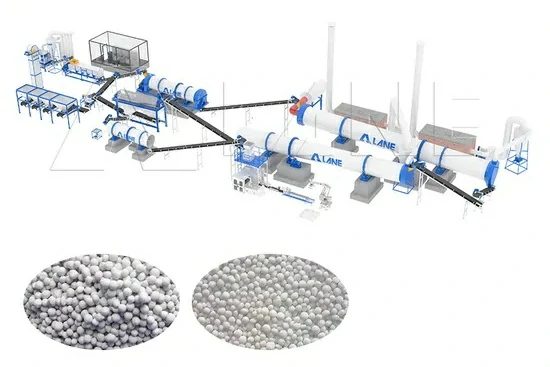
Equipment absorbs roughly 45 to 60 percent of a DAP project, a lower share than in NPK because acid storage, ammonia handling, and the scrubbing train add civil and structural scope. Civil works and foundations run 15 to 20 percent, installation and piping 12 to 18 percent, with engineering, commissioning, training, and spares taking the rest.
Within the equipment budget, the allocation is not intuitive. The granulator, dryer, and cooler take the largest single block, but the acid and ammonia section plus the scrubber can reach a quarter of the machinery cost. Materials of construction follow the DAP manufacturing process: wherever acid or ammonia touches steel, the alloy choice sets the price. Phosphoric acid at 54 percent P2O5 is aggressive, and the difference between rubber-lined, FRP, and alloy wetted parts shows up in year three, not on the invoice.
Published LANE budgets for complete granulation lines run from about USD 90,000 at 1 TPH to USD 2.0 million at 20 TPH. A DAP line with acid handling and scrubbing sits at the upper end of those bands, and any quote below the band deserves a scope audit rather than a celebration.
Capital is the easy number to compare. DAP production cost is the harder one, and it decides whether the plant survives a soft market.
Raw materials take 75 to 85 percent of DAP production cost per ton. The mass balance explains why. One ton of granular DAP at 18-46-0 contains 0.46 tons of P2O5 and 0.18 tons of nitrogen. At 54 percent P2O5, that is roughly 0.85 tons of phosphoric acid and 0.22 tons of ammonia per ton of product, before losses.
Everything else is smaller but not small. Drying and scrubbing consume the bulk of the electricity and fuel. Labor runs 3 to 6 percent of cost. Maintenance lands at 3 to 5 percent of equipment capital per year. Bags add 1 to 2 percent.
Because raw material dominates, DAP production cost per ton moves with phosphoric acid and ammonia prices, not with plant efficiency. A supplier cannot fix a bad P2O5 contract. What a well-designed line can do is hold the loss rate down: acid losses to the scrubber, ammonia slip, and off-spec recycle are the three places where a mediocre design quietly adds 3 to 8 percent to the cost of every ton.
Conveyors between the granulator and the packing scale are frequently quoted as site scope. On a DAP line that is 10 to 16 conveyors, and the gap can reach six figures.
Acid and ammonia storage is often treated as buyer scope. A rubber-lined acid tank farm and an ammonia bullet with the required safety systems are not small items, and they belong in the feasibility study, not in the contingency.
The scrubber is the classic omission. Ammonia and fluoride emissions are regulated in every jurisdiction we work in, and the World Bank Group’s Environmental, Health, and Safety Guidelines for Fertilizer Production are a reasonable baseline for what a permit will require. A line priced without gas treatment is not a complete line.
Spare parts, commissioning, operator training, and the first fill of chemicals are the last four. Together they add 8 to 12 percent to a realistic budget, and each one moves DAP fertilizer production line price more than the discount you were negotiating for.
Normalize every quote to the same four statements: capacity at a stated product analysis, a scope boundary drawing, a utility consumption table, and a performance test procedure. If a supplier cannot produce all four, the price is not comparable, however attractive the number looks.
The performance test should guarantee five values: output at the specified formula, total nitrogen, available P2O5, granule size distribution, and final moisture. Hardness is worth adding. Without those numbers, “guaranteed capacity” is a marketing phrase.
Then check references at your capacity and your feedstock. A supplier with twenty 5 TPH lines may never have commissioned a 20 TPH DAP train, and DAP is less forgiving than NPK because the recycle loop and the ammonia balance scale differently.
The wear parts on a DAP line are predictable: granulator scrapers, screener mesh, crusher hammers, slurry pump seals, and scrubber nozzles. Budget 3 to 5 percent of equipment capital per year and hold a two-year stock of the parts that stop the line when they fail.
Uptime is the cheapest lever on DAP production cost. It is a design outcome, not a maintenance outcome. Access platforms around the granulator, a spare screener deck, and a crusher sized for total recycle throughput will do more for availability than any preventive maintenance schedule.
How much does a DAP fertilizer production line cost?
Published LANE budgets for complete granulation lines run from about USD 90,000 at 1 TPH to USD 2.0 million at 20 TPH, including equipment, installation, civil works, and commissioning. A DAP line with acid storage and scrubbing sits at the upper end, and working capital sits outside those figures.
What drives DAP production cost per ton the most?
Phosphoric acid. One ton of DAP needs roughly 0.85 tons of 54 percent acid, so the P2O5 price sets the floor on cost. Ammonia is the second input at about 0.22 tons per ton of product.
Is the DAP manufacturing process different from MAP?
The DAP manufacturing process differs mainly in the ammonia ratio. Both use ammonia and phosphoric acid. MAP runs at a lower ratio, near 1:1, and finishes at 11-52-0. DAP runs near 2:1 and finishes at 18-46-0. The equipment train is similar, and many lines can switch with changes to the reactor and the ammonia control.
How much phosphoric acid does a ton of DAP require?
About 0.85 tons of merchant-grade acid at 54 percent P2O5, plus 0.22 tons of ammonia. Losses to the scrubber and off-spec recycle raise the real consumption above the stoichiometric figure.
Can one line make DAP and NPK?
Yes, with limits. A DAP train can run MAP and some NPK grades, but the recycle ratio and the ammonia system are sized for the DAP case. Ask the supplier to quote the second product as a separate performance point.
What capacity should a new DAP plant start with?
Most commercial projects land between 5 and 20 TPH. Below 5 TPH the acid and ammonia safety systems cost as much as the production equipment. Above 20 TPH, feedstock logistics and permit limits usually decide the site before the equipment does.
How long does delivery and installation take?
Eight to fourteen weeks of manufacturing, then 10 to 16 weeks for installation, commissioning, and the performance test. Greenfield sites add three to six months for civils.
Which certifications should a DAP supplier hold?
ISO 9001 is the baseline that public tenders ask for. For export to the European Union, the product must meet Regulation (EU) 2019/1009, including its cadmium limits for phosphate fertilizers, and the supplier should be able to document material certificates for wetted parts.
Copyright © Henan Lane Heavy Industry Machinery Technology Co., Ltd.
