
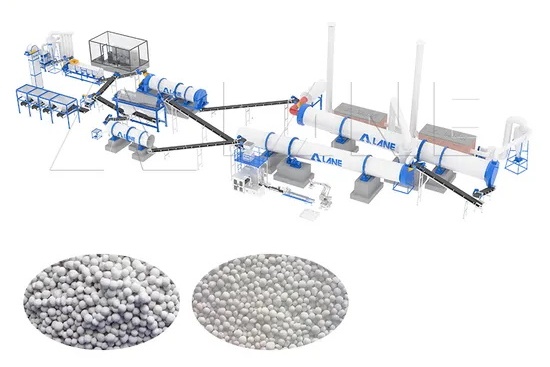
In a DAP fertilizer production plant, producing granules with a consistent size is not always easy. After granulation, drying, and cooling, the material usually needs to pass through a screening process before it can enter the packaging section. During this stage, some particles may be smaller or larger than the required product size. Fine powder and oversized granules are common materials that need further treatment.
Simply removing these off-size materials from the production line can lead to unnecessary material losses. For a plant operating continuously, even a small amount of rejected material can accumulate into a considerable quantity over time. This is why a DAP granulation recycle system is an important part of production line design.
Instead of treating every undersized or oversized particle as waste, manufacturers can collect, process, and return suitable materials to the granulation section. A properly designed recycle system helps improve material utilization, maintain a stable production process, and reduce the amount of material that needs to be discarded.
However, recycling is not simply a matter of sending all rejected particles back to the granulator. Different materials require different handling methods. Fine powder may be returned directly under suitable process conditions, while oversized granules usually need crushing before reuse. Understanding these differences is the first step in designing an effective DAP fertilizer production line.
Before selecting equipment, manufacturers should identify which materials are generated during screening and other production stages. In a typical DAP granulation process, three material streams may require attention.
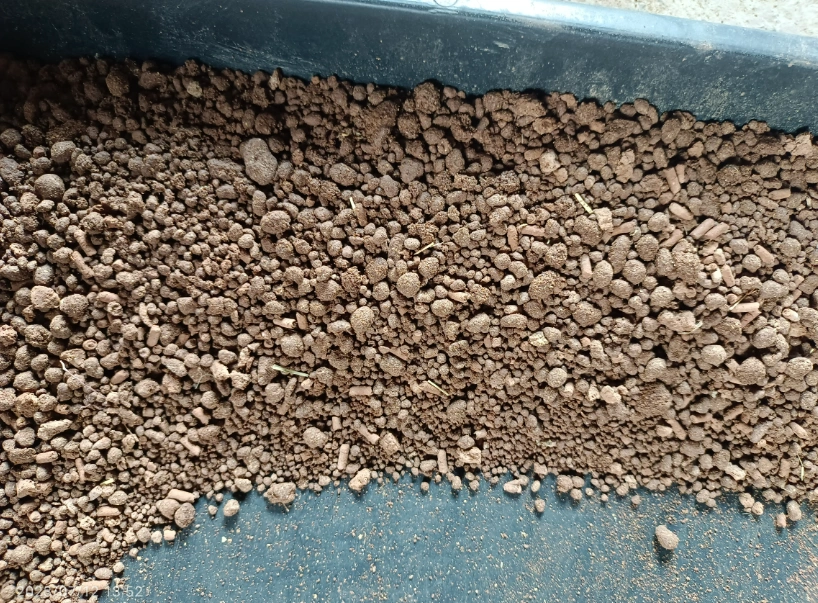
Fine particles and undersized granules
Fine particles are smaller than the required product size. They are usually separated by the screening machine after the drying and cooling stages. Depending on their moisture, chemical composition, and process conditions, these fines can be returned to the granulation section as part of the DAP granulation recycle process. In some processes, they act as recycle material or granulation nuclei that help new particles grow.
Oversized granules
Oversized granules exceed the required particle size. They cannot be mixed directly with qualified products because this would affect the final particle size distribution. In a DAP granulation recycle system, these granules are generally sent to a crusher, where they are reduced to a suitable size before being returned to the production process.
Collected dust
Dust can be generated during material transfer, screening, crushing, and other handling operations. A dust collection system can capture part of this material and prevent excessive dust from spreading around the plant. Whether collected dust can be returned to the DAP granulation recycle process depends on its composition, contamination level, and the plant’s process control requirements.
A well-planned DAP granulation recycle process should distinguish these materials instead of sending them through the same treatment route. This helps avoid unnecessary crushing, reduces the risk of introducing unsuitable material, and makes the overall recycling process easier to control.
The recycle system connects several production stages rather than operating as a single independent machine. Its main purpose is to separate off-size granules, process them according to their characteristics, and return suitable material to the granulation section.
A typical process can be divided into the following stages.
Screening and particle classification
After drying and cooling, DAP granules are conveyed to a screening machine. In the DAP granulation recycle process, the screen separates qualified granules from undersized and oversized particles according to the required product specifications.
For example, if a plant targets a finished particle size of 2–4 mm, the screening system needs to separate particles outside this range. The exact screen openings should be selected according to the product specification and actual operating conditions.
Qualified granules move forward to coating, storage, or packaging. The remaining materials enter the recycle process. You can learn more about the equipment arrangement in LANE’s article on screening equipment for MAP and DAP fertilizer.
Crushing oversized granules
Oversized particles are usually transferred to a crusher. In a DAP granulation recycle system, the purpose of crushing is to reduce their size so that they can be handled again by the granulation process.
The crushing equipment should be selected according to the hardness, moisture, and quantity of the oversized material. If the crusher produces too much fine powder, the recycle load may increase and create additional pressure on the screening and conveying sections.
Therefore, the crushing process should produce material that is suitable for reuse rather than simply reducing everything to the smallest possible size.
Collecting and returning fine particles
During DAP granulation recycle, undersized granules can often be collected separately and returned to the granulation section, provided their properties meet process requirements. The return point depends on the production design. Some plants introduce fines into the granulator as recycle material, while others combine them with selected feed materials before granulation.
Collected dust should be evaluated separately. It should only be reused when its quality and chemical composition are suitable for the process.
Conveying recycled materials back to granulation
After classification and treatment in the DAP granulation recycle process, conveyors or bucket elevators move the recycled materials to the designated return point. The material then joins the production process again.
A complete DAP granulation recycle system therefore relies on coordination between screening, crushing, conveying, and granulation equipment. If one section cannot handle the required material flow, the entire recycle loop may become unstable.
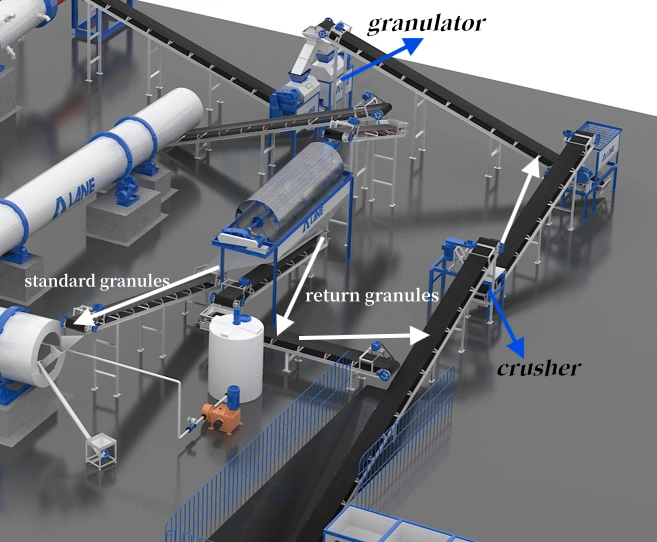
The equipment configuration depends on plant capacity, material characteristics, and the required finished product size. However, several machines are commonly considered when planning a recycle system.
Rotary or vibrating screening machine
In a DAP granulation recycle system, the screening machine separates qualified granules from fine powder and oversized particles. Its screening area, mesh size, and processing capacity should match the production line’s output. A suitable screening system helps prevent off-size particles from entering the finished product section.
Fertilizer crusher
A crusher is an important part of DAP granulation recycle, processing oversized granules before they return to the granulation section. The crusher model should be selected according to the material’s physical properties and the expected recycling volume. You can explore LANE’s fertilizer equipment product range to review available equipment, including crushing and screening machines.
Belt conveyors and bucket elevators
These machines connect the screening, crushing, and granulation sections to support continuous material flow in the DAP granulation recycle system. Belt conveyors are commonly used for horizontal or inclined material transfer, while bucket elevators move materials vertically. Their capacity and layout should be coordinated with the actual recycle flow to avoid material accumulation or feeding interruptions.
Granulation equipment
The granulator receives the fresh feed materials and suitable recycled materials. In a DAP fertilizer plant, the granulation section must be designed around the selected process, feed conditions, and production capacity. The amount and condition of recycled material can influence the granulation operation, so the return point and feeding rate need to be considered during system design.
Dust collection equipment
Dust collectors capture airborne particles generated during screening, crushing, and conveying. They help maintain a cleaner working environment and reduce material loss. Recovered dust should be assessed before being returned to production.
These machines should not be selected independently. A reliable DAP granulation recycle system requires the screening capacity, crusher output, conveyor capacity, and granulator feeding rate to work together.
A properly designed recycle loop can bring several practical benefits to a DAP fertilizer plant.
Better material utilization
Through DAP granulation recycle, suitable fines and crushed oversized granules can be returned to the production process instead of being discarded. This reduces avoidable material losses and helps manufacturers make better use of the material already processed.
More consistent finished granules
Screening removes particles that do not meet the required size range. Crushing and reprocessing oversized materials also prevent them from being mixed directly with qualified products. When the recycle loop is properly controlled, the plant can maintain a more consistent finished particle size distribution.
More stable continuous production
A well-coordinated recycle system allows rejected materials to move through a planned treatment route. This reduces the need for manual handling and helps the production line maintain a more organized material flow.
Better control of production costs
Material recovery can reduce the amount of usable material lost during production. It can also help operators identify problems in granulation, drying, or screening. For example, an increase in fine powder may indicate that the granulation conditions or material properties need adjustment.
However, recycling does not automatically guarantee lower production costs. Additional crushing, conveying, and handling also consume energy and require maintenance. The system should be evaluated according to the actual material balance and operating expenses.
A recycle system should be designed according to the actual production conditions rather than using the same equipment arrangement for every plant.
Production capacity
The screening machine, crusher, and conveying equipment must handle the expected material flow. The recycle section should be designed for both the fresh production feed and the additional returned material. Otherwise, equipment may become a bottleneck even when the main granulator has sufficient capacity.
Target particle size
The required finished granule size determines the screening specifications. A plant producing a 2–4 mm product needs a different screening arrangement from one targeting another particle size range. Screen selection should also consider the actual shape and distribution of the granules.
Recycle material ratio
The amount of fine powder and oversized granules can vary with raw material properties, moisture, granulation conditions, and equipment operation. Operators should measure the actual recycle quantity before determining the required equipment capacity. A fixed recycle ratio should not be assumed for every DAP production line.
Material moisture and physical properties
Moisture affects the flowability and handling of recycled materials. Excessively wet fines may stick to equipment or cause blockages, while very dry and dusty material may increase dust generation. The crusher and conveyor arrangement should also match the material’s hardness and particle characteristics.
Equipment layout and return points
The location of the screening machine, crusher, conveyors, and granulator affects the overall material flow. A practical layout should reduce unnecessary transfer distance, avoid sharp changes in conveying direction where possible, and provide enough space for inspection and maintenance.
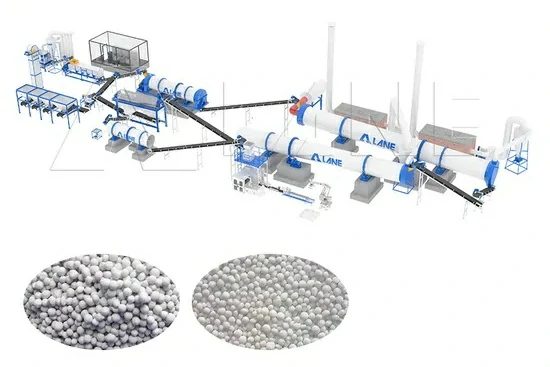
For a complete DAP plant, these considerations should be reviewed together with the reaction, granulation, drying, cooling, coating, and packaging sections. LANE provides DAP fertilizer production line solutions with equipment arrangements designed around different production requirements. The final configuration should be confirmed through material testing and engineering evaluation.
A recycle system is more than an additional group of machines. It is an important part of material flow management in a DAP fertilizer plant. By separating fine particles and oversized granules, crushing materials when necessary, and returning suitable material to the granulation section, manufacturers can reduce avoidable losses and improve production consistency.
An effective DAP granulation recycle system depends on the correct combination of screening, crushing, conveying, dust collection, and granulation equipment. Its design should take production capacity, particle size, moisture, and actual recycle volume into account.
LANE, a fertilizer equipment manufacturer, provides equipment and production line solutions for different fertilizer projects. With experience in fertilizer machinery, customized equipment design, and production line planning, LANE can help customers evaluate the required equipment configuration for their DAP projects.
If you are planning a new DAP fertilizer plant or upgrading an existing production line, you can contact LANE Heavy Industry to discuss your raw materials, target capacity, finished granule size, and recycle requirements. A suitable system starts with understanding the actual production process.
Copyright © Henan Lane Heavy Industry Machinery Technology Co., Ltd.
