
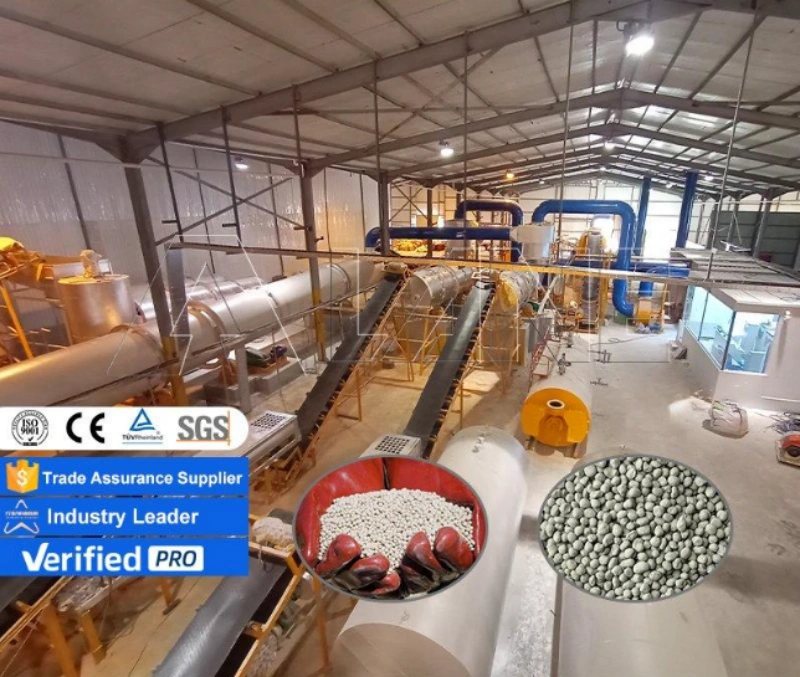
For fertilizer producers planning a new plant or upgrading an existing facility, an ammonium phosphate production line USA project involves much more than purchasing a granulator. Raw materials, reaction methods, product grades, production capacity, environmental controls, and site conditions all influence the final plant configuration.
A complete ammonium phosphate production line connects phosphoric acid and ammonia handling with reaction, ammoniation, granulation, drying, cooling, screening, material recycling, storage, and packing. Each section affects the performance of the next. If the reaction system produces unstable slurry, for example, the granulator may struggle to maintain consistent particle sizes. If the drying and screening sections are not properly matched to the granulation capacity, the entire line may experience bottlenecks.
This guide explains how to evaluate an ammonium phosphate production line USA project for MAP, DAP, or related phosphate fertilizer products. It covers the production process, main equipment, project considerations, and the information buyers should prepare before requesting a technical proposal from an equipment supplier.
An industrial phosphate fertilizer plant should deliver consistent product quality, stable operation, and a clear production process from raw-material input to finished fertilizer. Before selecting equipment, buyers should define what they expect the plant to produce and how much product they need.
The term ammonium phosphate production line USA can refer to several different project types. Some investors need a complete greenfield plant, while existing fertilizer manufacturers may only need to expand their production capacity. Other projects focus on replacing an inefficient granulator, adding a drying section, or upgrading the screening and recycling system.
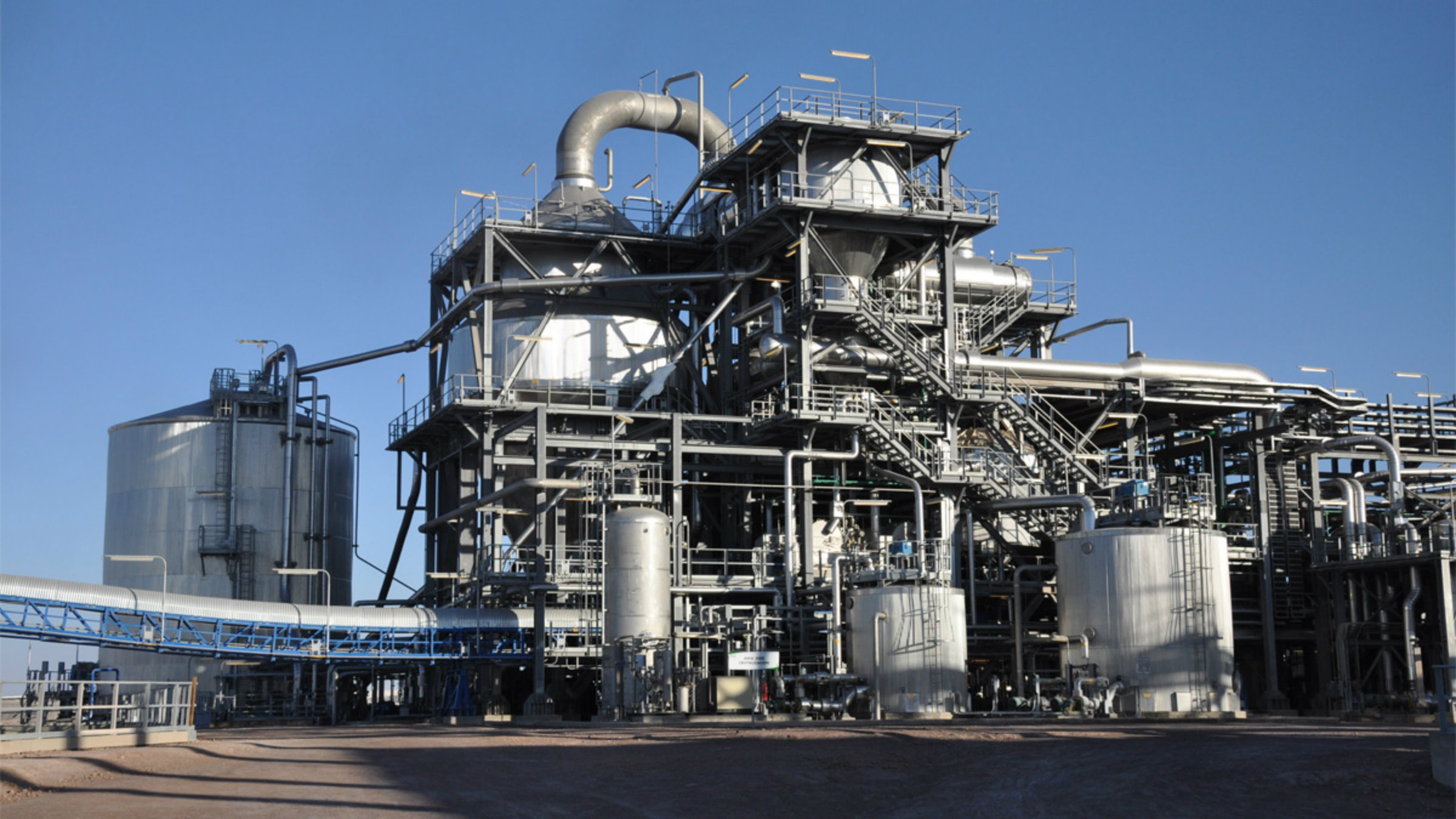
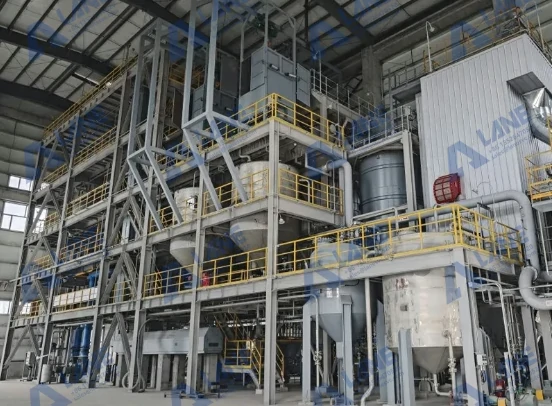
A complete project may include phosphoric acid storage tanks, ammonia storage and metering systems, a preneutralizer or pipe reactor, an ammoniator-granulator, a rotary dryer, a cooler, vibrating screens, crushers, conveyors, dust collectors, scrubbers, product bins, packing equipment, and electrical control systems.
For an existing facility, however, installing a completely new production line may not be necessary. A new granulation section could be connected to existing raw-material handling, utilities, storage, or packing systems, provided that the existing equipment has sufficient capacity and is technically compatible.
The expected result should be defined in measurable terms. These may include:
A suitable ammonium phosphate production line USA should be designed around these requirements rather than selected only by comparing the rated capacity of individual machines. Buyers should also consider maintenance access, equipment replacement space, and possible future expansion.
MAP and DAP are two common ammonium phosphate fertilizers. Although they share phosphoric acid and ammonia as their main raw materials, their nutrient grades and process requirements are different.
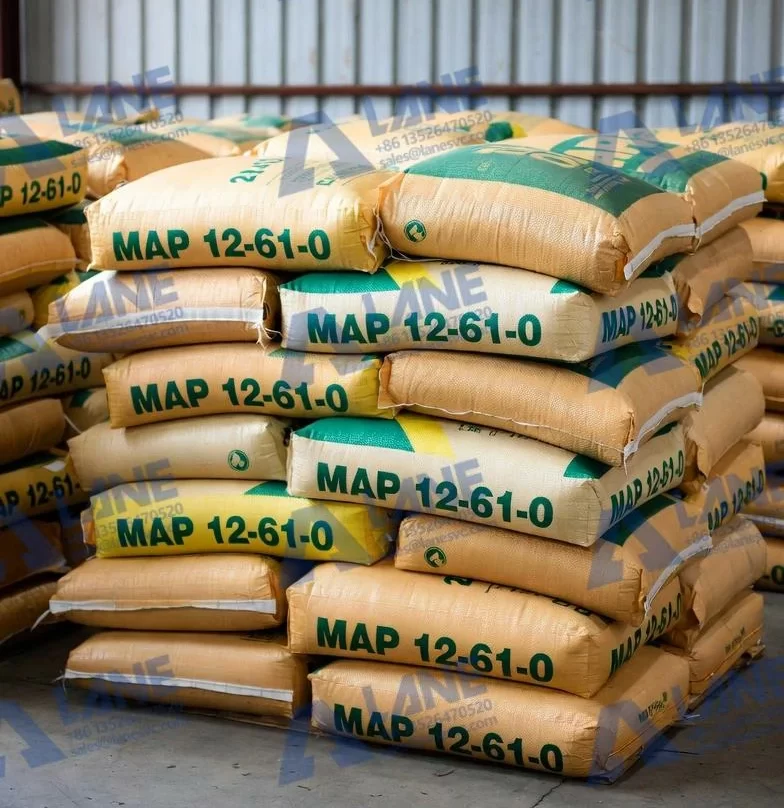
DAP is commonly associated with the 18-46-0 grade, while MAP is commonly associated with the 11-52-0 grade. These are widely recognized grades, but actual product specifications depend on raw-material quality, process chemistry, formulation, and the requirements of the target market.
When planning an ammonium phosphate production line USA, buyers should first decide whether they intend to produce MAP, DAP, or both. This decision affects the reaction system, operating conditions, granulation process, and equipment configuration.
A plant designed for one product may not be able to switch to another product without adjustments. For example, the ammonia-to-acid ratio, slurry properties, moisture balance, recycle composition, and screening settings may need to change. A flexible production system can be useful for manufacturers serving different fertilizer markets, but its operating range and product changeover requirements should be confirmed before equipment is ordered.
Some producers may also want to manufacture NPK fertilizers using phosphate-based materials. In this case, the project may require additional raw-material feeding and formulation systems. The supplier should clarify whether the proposed line is intended for MAP or DAP production only, or whether it can accommodate other fertilizer formulations.
The product strategy should be supported by raw-material information and, where necessary, testing. A machine selected only from a catalogue capacity may not achieve the expected product quality if the actual phosphoric acid concentration, impurities, temperature, or moisture differs from the original design assumptions.
For reference, buyers can review the dedicated MAP production line and DAP production line to understand how different phosphate fertilizer products may require different production configurations.
The ammonium phosphate fertilizer process combines chemical reaction with physical granulation. Although the exact process flow varies according to the product and plant design, a typical production line includes raw-material preparation, reaction, ammoniation, granulation, drying, cooling, screening, and recycling.
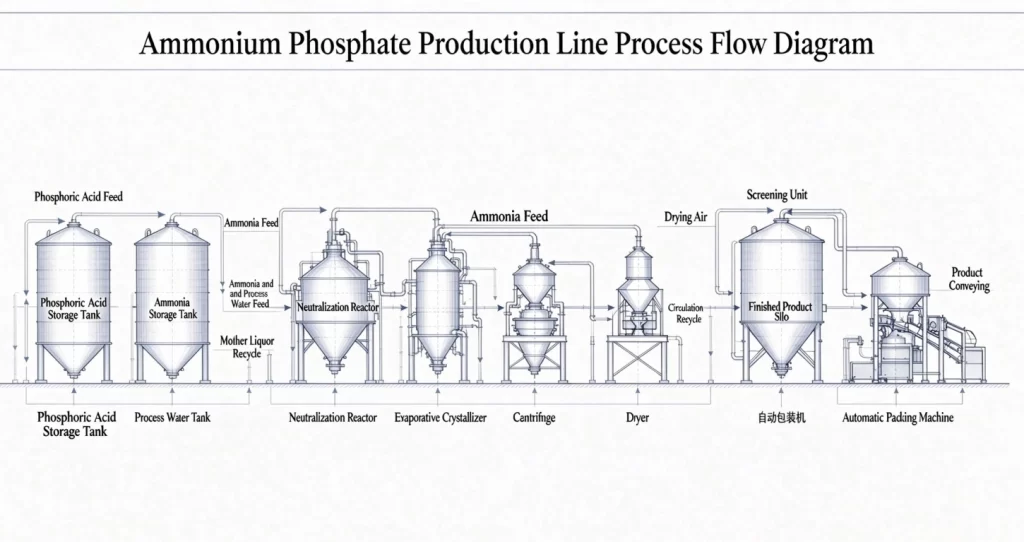
First, phosphoric acid and ammonia are stored and supplied to the production system through controlled feeding equipment. The materials then enter a preneutralizer, pipe reactor, or another selected reaction system. Their reaction produces heat and an ammonium phosphate slurry or melt.
The resulting material is transferred to an ammoniator-granulator. At this stage, the slurry combines with recycled fines and seed particles. As material moves through the granulator, particles grow through coating and agglomeration until they reach a suitable size.
The wet granules then enter a drying section to reduce moisture. After drying, a cooler lowers the product temperature before screening. The screening system separates finished-size granules from undersize and oversize materials. Oversize particles are crushed, while fines and crushed material are returned to the granulation circuit.
This recycling process helps maintain a suitable granulation bed and improves material utilization. However, excessive recycling can increase the load on conveyors, screens, crushers, and the granulator. It may also reduce the amount of fresh material that the line can process. Therefore, the recycle ratio should be considered during process design rather than treated as a minor operating detail.
For an ammonium phosphate production line USA project, the process flow diagram should clearly show material streams, gas streams, recycle streams, and finished-product routes. Buyers should be able to identify where raw materials enter, where dust and process gases are collected, where moisture is removed, and where the finished fertilizer is sent for storage or shipment.
The raw-material preparation section also deserves attention. Phosphoric acid concentration, temperature, and impurities can affect reaction behavior. Ammonia supply pressure, temperature, and flow stability influence neutralization and product composition. Tanks, pumps, valves, meters, and instruments should therefore be selected as part of the complete process system.
The reaction system may use a preneutralizer, a pipe reactor, or a combined configuration. Each option affects water balance, residence time, heat recovery, slurry behavior, and the load placed on the dryer. The appropriate choice depends on the required capacity, product type, and operating conditions.
The granulator, dryer, cooler, and screening system must also work together. The granulator supports slurry coating and granule growth, while the dryer controls product moisture and the cooler prepares the granules for screening and storage. A well-designed line should balance production capacity, product quality, energy consumption, and recycle load rather than focusing on the output of one machine.
An ammonium phosphate production line USA proposal should make the equipment scope clear. Buyers need to understand which machines are included, which systems are supplied by other contractors, and which items are optional.
The main equipment groups commonly considered in a complete phosphate fertilizer project include:
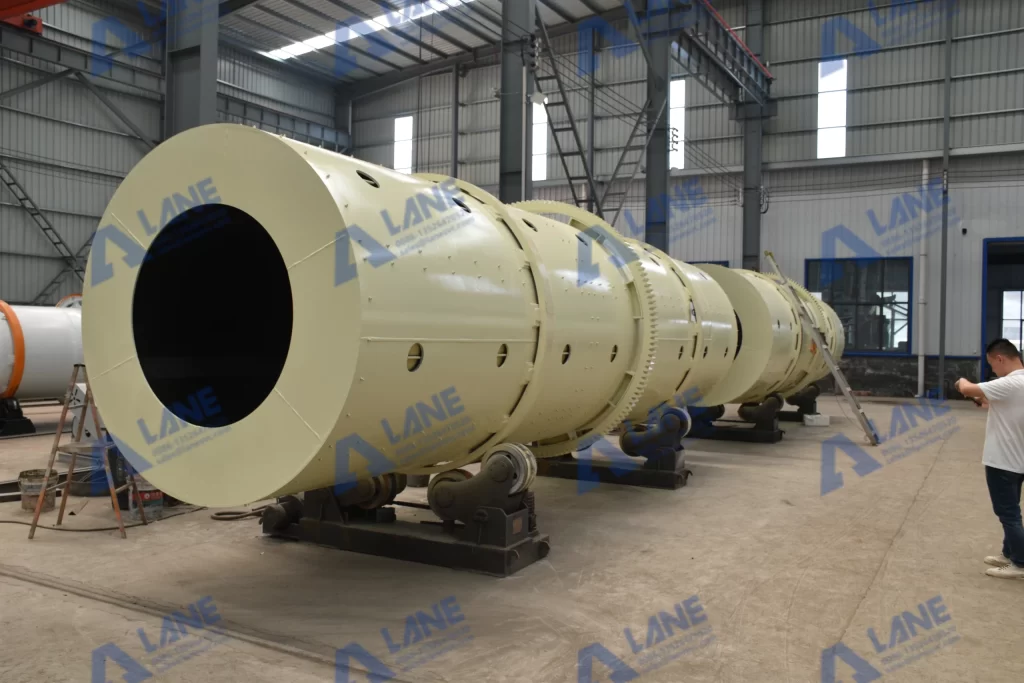
The equipment list should be accompanied by a clear description of the project boundaries. For example, the proposal should identify where raw materials enter the system, where utilities connect, where emissions leave the process, and where finished product is handed over.
For an existing fertilizer plant, equipment compatibility is especially important. A replacement granulator must work with the current dryer, screens, conveyors, dust collection system, and recycle circuit. Before recommending an upgrade, the supplier should review the existing layout, equipment dimensions, operating data, production bottlenecks, and maintenance history.
A new machine may have a higher rated capacity than the old one, but that does not automatically mean the whole plant can produce more. If the dryer, screen, or conveyor system cannot handle the additional output, the actual production capacity will remain limited by the weakest section.
For this reason, an ammonium phosphate production line USA project should be evaluated as an integrated system. Buyers can also review the company’s fertilizer equipment manufacturing background when comparing potential suppliers.
Environmental control should be considered during the early design stage of an ammonium phosphate plant. The production process may generate ammonia, fluoride compounds, and particulate emissions around the reaction system, ammoniator-granulator, dryer, cooler, screens, and material-transfer points.
The actual environmental control configuration depends on raw materials, process chemistry, production capacity, plant layout, and local permit requirements. It should not be assumed that one standard dust collector or scrubber configuration will suit every project.
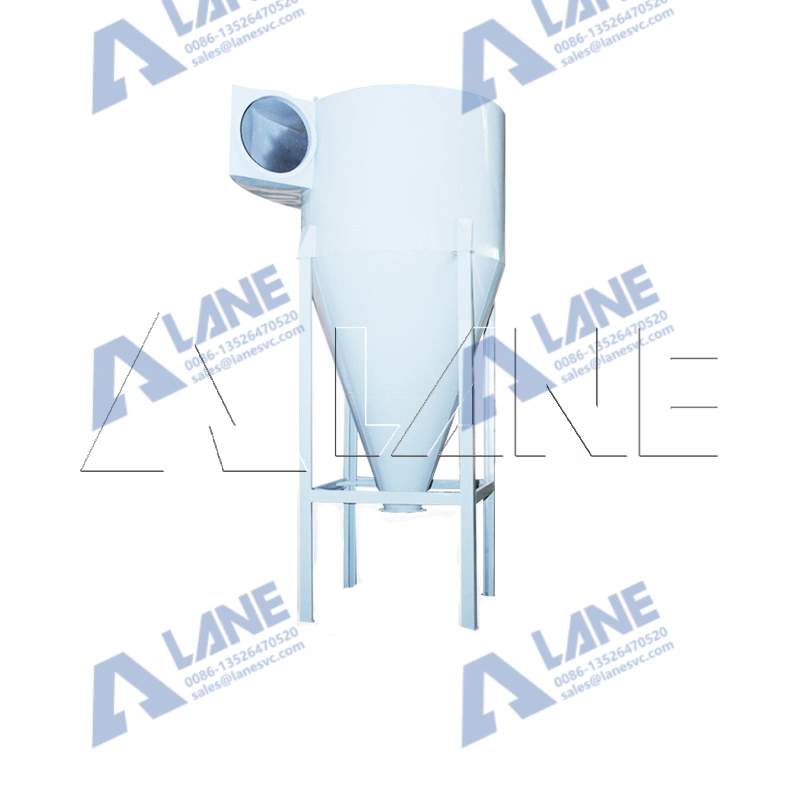
Cyclones may be used for coarse particulate collection, while bag filters can help control dry dust at selected collection points. Wet scrubbers may be considered for certain gas streams. Depending on the process chemistry and operating plan, some recovered material or scrubbing liquor may be suitable for return to the production system.
The design should also consider equipment corrosion resistance, inspection access, sealing at material-transfer points, emergency shutdown arrangements, ammonia detection, safe drainage, and maintenance isolation. These details are important for long-term operation and should be discussed before equipment manufacturing begins.
For an ammonium phosphate production line USA, local engineering and permitting requirements must be confirmed for the specific state and site. An equipment supplier can provide process information, emission-point descriptions, utility data, equipment drawings, and control-system details. However, a local environmental or engineering professional may still be required to prepare permit applications and confirm site-specific compliance.
Buyers should therefore request clear technical documentation rather than relying on general claims that a production line is environmentally friendly or automatically meets every local regulation.
Before selecting equipment, buyers should prepare a basic project data package. This helps the supplier understand the actual production conditions and reduces the risk of designing a line around incorrect assumptions.
The first step is to confirm the raw materials. Useful information includes the phosphoric acid source, acid concentration, available laboratory analysis, expected impurities, ammonia supply condition, and any existing storage or feeding facilities. If laboratory reports or material samples are available, they can support a more accurate process review.
The second step is to define the finished product. Buyers should specify whether they need MAP, DAP, NPK, or a combination of products. They should also provide the target nutrient grade, particle-size range, moisture limit, granule strength requirements, and intended packaging method.
Production capacity must be described clearly. Annual output alone may not be sufficient for equipment selection. The supplier should also know the expected operating hours per day, working days per year, and required hourly production capacity. These details influence equipment sizing and the design of the drying, screening, conveying, and recycling sections.
For an existing plant, buyers should provide the current layout, available building dimensions, utility conditions, equipment specifications, and known production problems. Photos and videos of the current facility can also help the engineering team understand installation conditions.
Raw-material testing is another useful step when the material properties or process behavior are uncertain. Testing can help evaluate whether the available phosphoric acid and ammonia can produce the required MAP or DAP grade, whether the slurry behaves consistently, and whether the proposed granulation method can achieve the target particle size and strength.
Testing may include feasibility assessment, product testing, continuous process testing, and scale-up. The results should identify the tested conditions, observed product properties, equipment assumptions, possible process risks, and recommended next steps.
This information also supports a more realistic investment estimate. Dryer capacity, gas handling, recycle capacity, equipment dimensions, and utility consumption should be based on the actual process requirements rather than a generic catalogue figure.
A fertilizer producer evaluating an ammonium phosphate production line USA project should understand how the project will move from initial planning to stable production. Equipment delivery is only one part of the process. Technical review, equipment coordination, installation, commissioning, and operator training also affect the final result.
A typical project may follow these stages:
During commissioning, the operating team may need to adjust feed rates, moisture levels, recycle quantities, dryer temperatures, screening settings, and gas-treatment conditions. These adjustments should be recorded so that operators can understand the relationship between process settings and finished-product quality.
Before placing an order, buyers should clarify what commissioning support is included, whether remote or on-site technical assistance is available, which documents will be provided, and how operating problems will be handled after start-up.
For more information, readers can review the company’s guidance on DAP fertilizer plant commissioning, DAP granulation recycle, and phosphoric acid storage tank selection.
A useful inquiry should provide more information than a general request for a fertilizer plant quotation. The more clearly the project requirements are described, the easier it is for the supplier to recommend a suitable process and equipment configuration.
When contacting a supplier about an ammonium phosphate production line USA, buyers should prepare the following information:
It is also important to explain the project scope. Is the buyer planning a complete new plant, expanding an existing facility, or replacing only part of the production system? This distinction helps the supplier avoid quoting unnecessary equipment or overlooking important connections to existing systems.
LANE Heavy Industry can review the product requirements, raw-material information, and target capacity to help define a suitable phosphate fertilizer production configuration. The equipment scope and process proposal should be based on the actual project conditions, not simply on a standard machine list.
If you are planning an ammonium phosphate production line USA project, prepare your product grade, capacity, raw-material data, granule size, and plant location before starting the technical discussion. You can contact the LANE project team to discuss the required process, equipment configuration, and next steps.
An ammonium phosphate production line USA project should be evaluated as an integrated production system rather than a purchase of one granulator or dryer. Raw-material handling, reaction, ammoniation, granulation, drying, cooling, screening, recycling, environmental control, storage, and automation all influence the final plant performance.
The right equipment configuration depends on the target product, raw-material properties, required capacity, existing facilities, and local project conditions. Before manufacturing begins, buyers should confirm the process route, define the equipment boundaries, review the necessary testing, and agree on measurable acceptance criteria.
A clear project scope makes it easier to compare suppliers, estimate investment requirements, coordinate installation, and prepare for stable operation. For producers planning MAP or DAP fertilizer manufacturing in the United States, a detailed process review is the most practical starting point for selecting a suitable ammonium phosphate production line.
Copyright © Henan Lane Heavy Industry Machinery Technology Co., Ltd.
